
Celtic and Rangers have been ordered to play their next Scottish Cup fixture behind closed doors after the Scottish Football Association ruled that neither club had done enough to prevent the violence that erupted at Ibrox in March.
The decision follows an independent review into the chaotic scenes that broke out after Celtic beat Rangers 4-2 on penalties in the Scottish Cup quarter-final on March 8. It means the next time the two sides are drawn against each other in the competition, neither set of supporters will be allowed inside the ground.
What happened at Ibrox
Celtic won the quarter-final on penalties after a 0-0 draw that went to extra time. When the final kick went in, Celtic supporters flooded onto the pitch to celebrate.
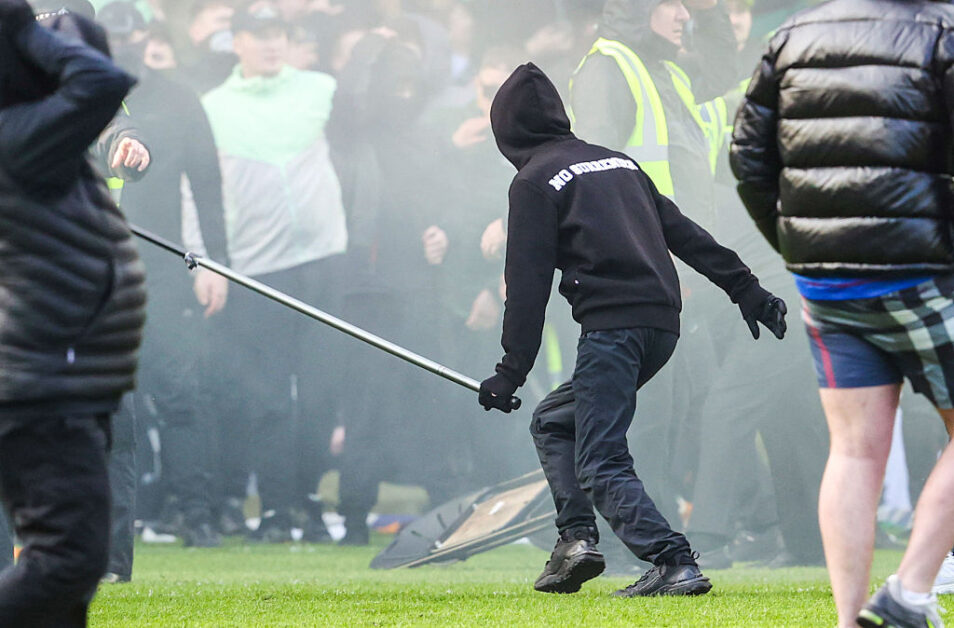
What happened next turned a pitch invasion into something much worse. Hundreds of Rangers fans, many of them from the section housing the Union Bears ultras group, charged towards the Broomloan Stand where 7,500 Celtic supporters were seated. A lit flare was launched towards the Celtic end. Fans threw missiles and punches. Police and stewards were forced to form a human barrier across the pitch to keep the two groups apart.
A female officer was kicked to the ground from behind by a Rangers fan who was sprinting towards the Celtic end. A 10-year-old child was hit by a coin. An officer was struck on the head by a bottle.
Celtic defender Julian Araujo was pushed by one fan and had another aim a kick at him. Teammate Tomas Cvancara appeared on television afterwards with bloodstains on his kit. A member of Celtic’s coaching staff was assaulted. A 47-year-old man was arrested in connection with that incident.
Police Scotland said officers and stewards faced ‘extreme hostility and violence over a sustained period, with many individuals having armed themselves with items clearly intended to cause harm’.

The review
An independent review was published in July. It found ‘planning inadequacies’ and identified two ‘near misses’ where the violence could have been significantly worse.
Rangers issued a statement at the time saying the disorder was ‘unacceptable’ and that they ‘unreservedly condemn those who forced entry, entered the field of play, engaged in violence, used pyrotechnics or threw missiles, vandalised the stadium, burned tifo materials or directed abhorrent abuse at the victims of the Ibrox Disaster’.
Celtic maintained that the initial pitch invasion by their supporters was ‘not, in itself, a major or threatening incident’ and that the violence was caused by what followed from the Rangers end.
Both clubs were charged by the SFA.
What the behind closed doors ruling means
The next time Celtic and Rangers are drawn against each other in the Scottish Cup, the match will be played in an empty stadium. No home fans. No away fans. Television cameras and essential staff only.
It is the most severe sanction the SFA can impose short of expulsion from the competition. Keith Wyness, former Aberdeen chief executive, said this week that stadium closures were ‘the ultimate sanction’ available and warned that if trouble continued, further bans could follow.
The decision also effectively ends the debate about away fan allocations in Old Firm fixtures. Celtic were given 7,500 tickets for the quarter-final at Ibrox, the largest away allocation since 2018. Police had already said that ‘large away supporter groups’ at Old Firm matches were ‘not safe’. This ruling removes the question entirely, at least for the next meeting in the Scottish Cup.
What happens in the league
The ruling applies specifically to the Scottish Cup. It does not automatically extend to Scottish Premiership fixtures between the two clubs, though the review’s findings could influence how future league derbies are managed.
Rangers and Celtic are due to face each other in the Premiership multiple times during the 2026-27 season. Away allocations for those matches have been a point of contention for years, ranging from around 750 to zero depending on the fixture and the political mood between the clubs.
Whether the Premiership follows the SFA’s lead and imposes its own restrictions remains to be seen. For now, the Scottish Cup is the competition that saw the worst violence Scottish football has witnessed in years, and it is the Scottish Cup that has acted first.
Related Articles:
Ex-SFA chief gives grim prediction on fan punishment after Rangers vs Celtic crowd trouble
 Mohamed Diomande joins Arca Çorum FK from Rangers — Ben Jacobs
 What do Scotland need against Brazil to qualify for the Round of 32 in the FIFA World Cup 2026?
 Zlatan Ibrahimovic warned ‘Scottish people won’t like that’ after brutal Celtic comment
 What do Scotland need to qualify for Round of 32 at FIFA World Cup 2026 after 3-0 loss to Brazil?
 Mika Baur to Celtic: €8m deal agreed
Related Articles:
Ex-SFA chief gives grim prediction on fan punishment after Rangers vs Celtic crowd trouble
Mohamed Diomande joins Arca Çorum FK from Rangers — Ben Jacobs
What do Scotland need against Brazil to qualify for the Round of 32 in the FIFA World Cup 2026?
Zlatan Ibrahimovic warned ‘Scottish people won’t like that’ after brutal Celtic comment
What do Scotland need to qualify for Round of 32 at FIFA World Cup 2026 after 3-0 loss to Brazil?
Mika Baur to Celtic: €8m deal agreed
